ANTICIPATING
Predict the kinds of choices students will make: rushing, playing too locally, overvaluing risky long-range moves, or missing larger board threats.
This page is designed to help parents, teachers, and students understand what CORRELATION develops during play. The primary focus is Mathematical Habits of Mind. Additional cognitive and personal benefits are included secondarily.
CORRELATION is a fast-paced system management game where players connect nodes across a dynamic board while managing risk, instability, and timing.
Important: CORRELATION does not teach mathematical content
(formulas, procedures, or curriculum). Instead, it develops the underlying
cognitive skills that mathematics education research identifies as essential: Reasoning, Decision-making, Pattern recognition, and Reflection.
These are exactly what Mathematical Habits of Mind literature argues
mathematics education should cultivate.
CORRELATION feels like managing an unstable system under pressure. The player scans a changing board, commits to an energy source, judges risk, aims a connection, and then lives with the consequence. Success feels corrective and explosive. Failure makes the board harder. The player is not just making moves. The player is learning to read a system, prioritize under pressure, and act with intention.
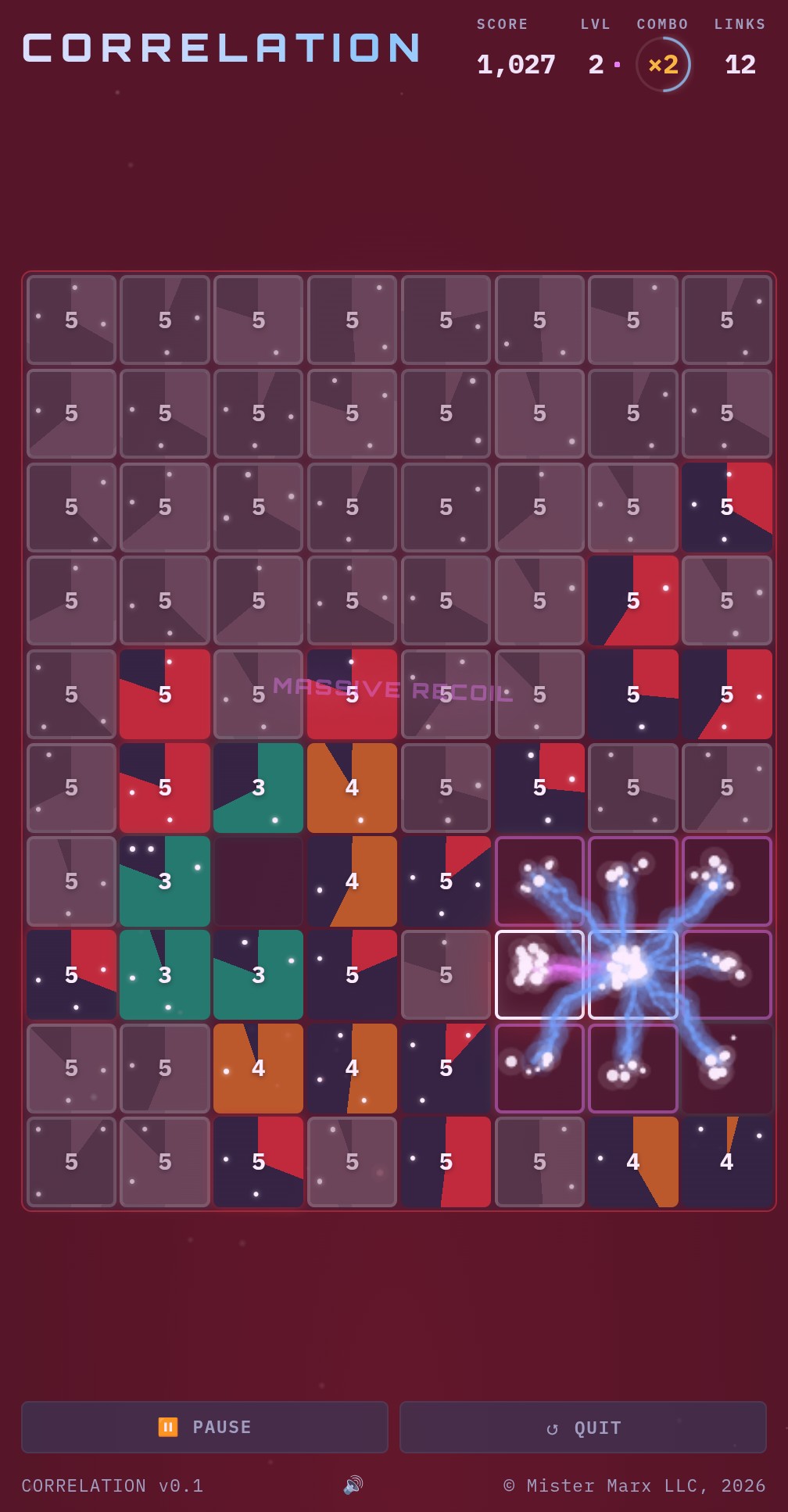
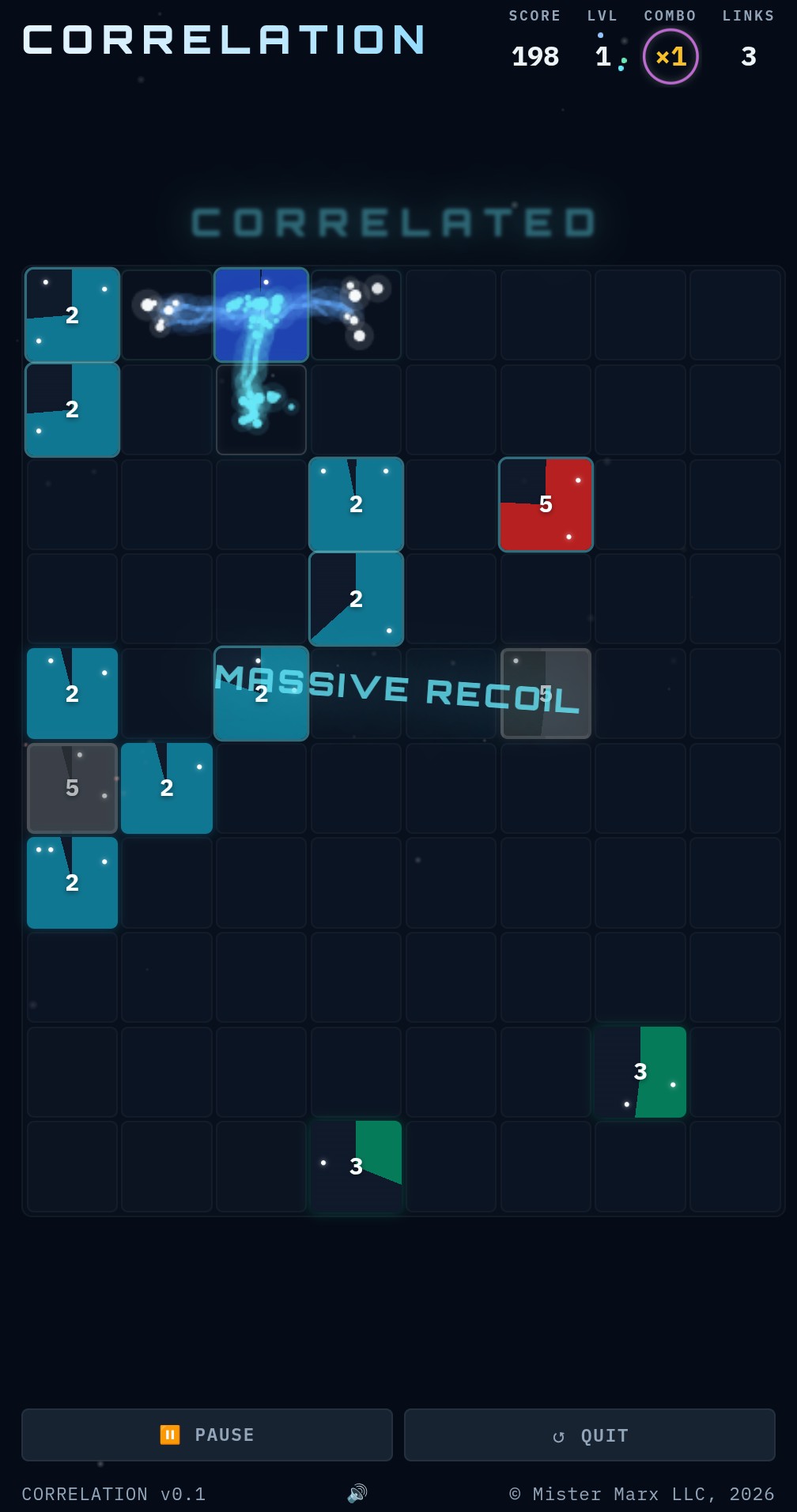
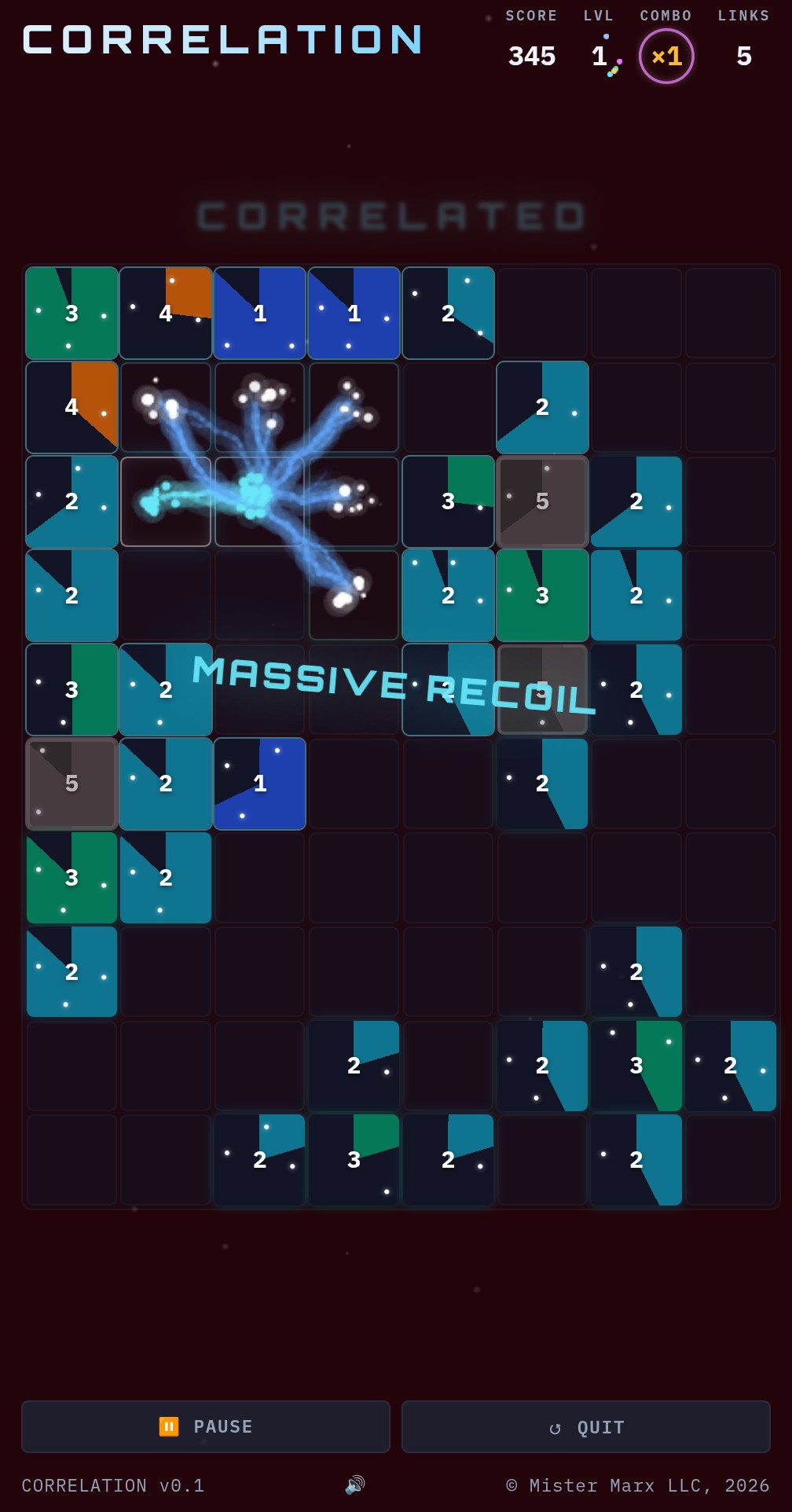
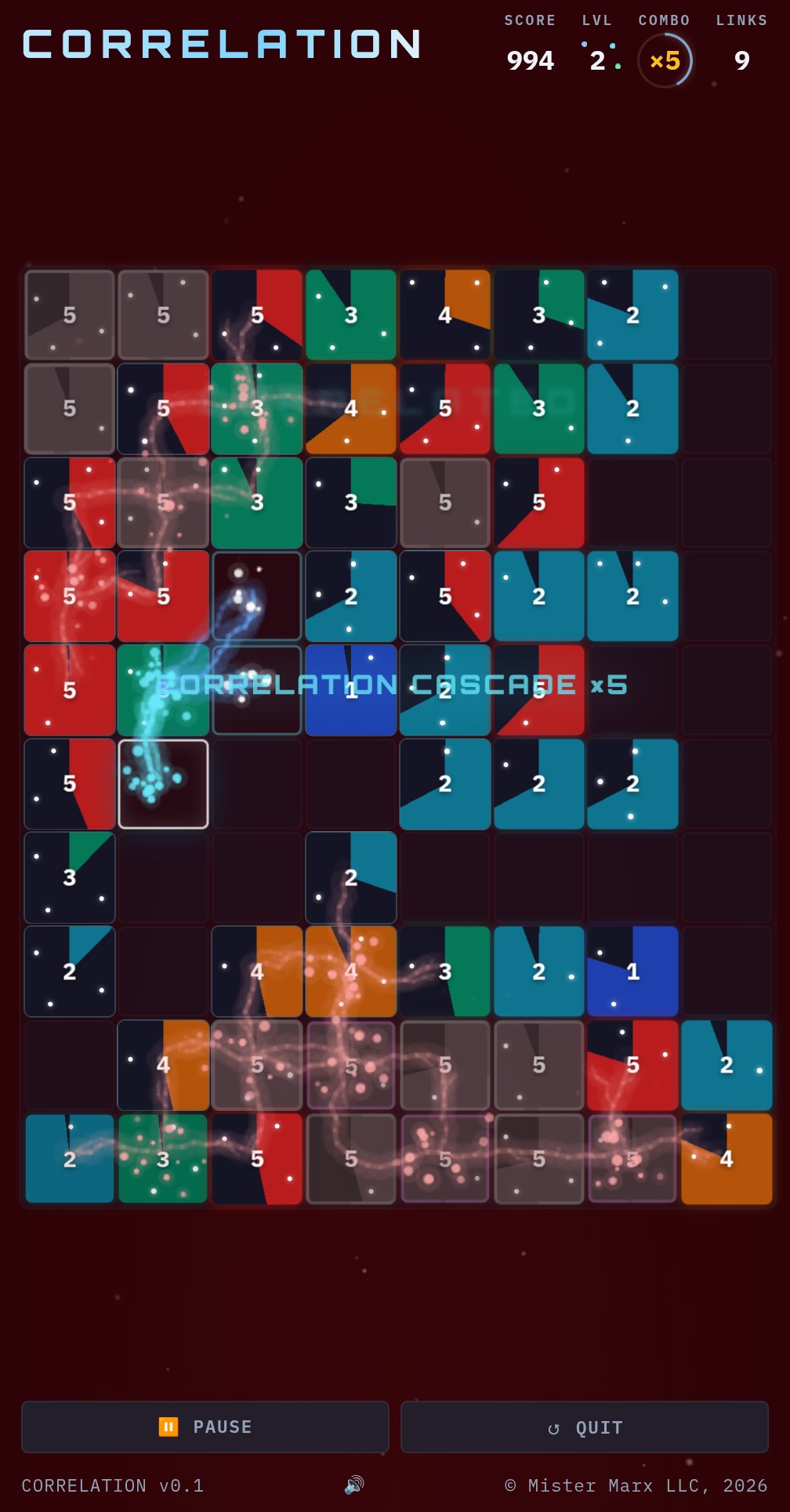
scan → select → aim → risk → release → consequence
The board is active, time-sensitive, and unstable. The player reads the current state, chooses a source, evaluates remaining nodes, decides whether the move is worth the risk, and responds to the outcome.
This is not a calm static puzzle. It is a pressure-based decision game where the player must balance urgency, precision, and restraint.
This companion page explains the play experience, the habits of mind the game can develop, and the kinds of decisions players are asked to make. It does not reveal every hidden or underlying system of the game. Some details are intentionally left for player discovery.
Not every underlying mechanic is explained on this page or in the game's instructions. Some systems are left partly hidden so that players can notice patterns, test ideas, form conjectures, and learn through discovery (Cuoco, Goldenberg, & Mark, 1996) . The goal is not to remove depth by over-explaining every variable. The goal is to preserve meaningful exploration while still giving players, parents, and teachers enough structure to use the game intentionally.
The essential rules of play should still be made clear: how to start a move, how to select a second node, that risk changes across situations, that failure has consequences, and that the board becomes harder if left unmanaged. Discovery should deepen play, not make the game unreadable.
The Mathematical Habits of Mind framework originates from research on mathematics curriculum design emphasizing reasoning, conjecture, and structural thinking (Cuoco, Goldenberg, & Mark, 1996) and is further developed in MisterMarx.com's educational approach (MisterMarx.com, 2026) . This approach builds on research showing that games create effective learning environments (Gee, 2003) , support cognitive development (Green & Bavelier, 2003) , and benefit from structured mathematical discussions (Stein, Engle, Smith, & Hughes, 2008) .
This companion page builds on established research in mathematics education, cognitive development, and game-based learning.
Mathematical Habits of Mind: Mathematics education should cultivate ways of thinking, not just procedures (Cuoco, Goldenberg, & Mark, 1996) .
Mathematical Discussion Theory: The 5 Practices framework for turning activity into reasoning (Stein, Engle, Smith, & Hughes, 2008) .
Inquiry Learning: Discovery learning improves conceptual retention (Bruner, 1961) .
Game-Based Learning: Games create situated problem-solving environments (Gee, 2003) .
Cognitive Skill Development: Action games improve attention and decision making (Green & Bavelier, 2003) .
Because some mechanics are left for discovery, players are pushed to make sense of the system, notice regularity, test ideas, explain outcomes, and revise their thinking from experience. That design choice directly supports Mathematical Habits of Mind (Cuoco, Goldenberg, & Mark, 1996) as applied in MisterMarx.com's educational approach (MisterMarx.com, 2026) .
The ratings below show which Mathematical Habits of Mind are most strongly activated by the actual play experience of CORRELATION.
These scores are not claims about all games in general. They describe how strongly CORRELATION appears to activate each Mathematical Habit of Mind through its actual play experience.
The player must constantly interpret a changing board before acting (MisterMarx.com, 2026) .
Strong play depends on being able to explain why one move is safer, stronger, or more urgent than another (MisterMarx.com, 2026) .
Players improve by noticing recurring board states, danger patterns, and reliable move structures (MisterMarx.com, 2026) .
The game repeatedly asks the player to recover, rethink, and continue after pressure or failure (MisterMarx.com, 2026) .
Errors are visible, consequential, and highly informative for future decision-making (MisterMarx.com, 2026) .
The board often offers several playable options, and stronger players compare them rather than acting immediately (MisterMarx.com, 2026) .
Players can clearly describe what they saw, what they intended, and what result they expected (MisterMarx.com, 2026) .
The game supports strong reflection on how choices changed the board and what better reasoning would look like next time (MisterMarx.com, 2026) .
Players begin forming broad rules from repeated play about urgency, safety, and payoff (MisterMarx.com, 2026) .
Good play depends on seeing how one local decision affects the wider board (MisterMarx.com, 2026) .
The game naturally produces real questions about risk, priority, and consequence (MisterMarx.com, 2026) .
The board acts as a visual representation of a dynamic system that players must interpret (MisterMarx.com, 2026) .
Some Mathematical Habits of Mind appear most strongly during discussion rather than during solo gameplay.
These habits emerge most clearly when gameplay is paired with conversation, reflection, and comparison of strategies.
The CORRELATION game emphasizes mathematical thinking behaviors rather than specific grade-level content. Alignment is evaluated against the Common Core Standards for Mathematical Practice (CCSS-MP).
Players constantly interpret evolving board states and determine possible node transitions. Failed correlations require re-evaluation and strategic adjustment, reinforcing perseverance and problem solving.
Gameplay Evidence:
Players reason about relationships between energy values, spatial distance, and probabilistic outcomes. Quantitative relationships guide strategic decisions.
Gameplay Evidence:
While the game itself is single-player, discussion about strategy allows players to justify choices and evaluate alternative reasoning.
Gameplay Evidence:
The game represents a simplified mathematical system involving quantities, probability decay, and cascading system responses.
Gameplay Evidence:
The primary tools are visual cues within the interface rather than external mathematical instruments.
Gameplay Evidence:
Successful play requires careful comparison of energy levels and precise selection of target nodes.
Gameplay Evidence:
Strategic play depends on recognizing patterns within the grid and understanding structural relationships between nodes.
Gameplay Evidence:
Repeated play reveals patterns in probability behavior and cascading effects, allowing players to develop strategic heuristics.
Gameplay Evidence:
There is benefit to not explaining every hidden mechanic immediately. Leaving some structure undisclosed creates opportunities for students to hypothesize, compare observations, justify claims, and debate what they think is happening in the system. This exposes the learning via inquiry and reasoning that is naturally occuring during gameplay.
Keep sessions short and reflective. A strong routine is play → pause → explain → play again. That turns the game into a thinking tool instead of passive screen time.
Your child does not need every rule explained in advance. In many cases, it is better to ask what they notice, what they predict, and what they think caused a success or failure. That helps the game become a thinking experience rather than just an instruction-following experience.
Part of the game is discovery. You are not supposed to be told every hidden detail right away. Pay attention to what seems to make a move safer, riskier, stronger, or more dangerous. Your task is not just to play. Your task is to notice and wonder.
Research on productive mathematics discussions identifies five instructional practices: anticipating, monitoring, selecting, sequencing, and connecting student thinking (Stein, Engle, Smith, & Hughes, 2008) .
Predict the kinds of choices students will make: rushing, playing too locally, overvaluing risky long-range moves, or missing larger board threats.
Watch and listen for how students justify moves, how they react to failure, and whether they are reading the board globally or only one piece at a time.
Choose students whose moves show contrasting reasoning: careful stabilization, impulsive overreach, strong recovery, or powerful pattern recognition.
Share examples in an order that helps the class move from surface-level description toward stronger system-based explanation.
Connect one player’s reasoning to another’s so students can see how different decisions reveal larger mathematical habits of mind.
The player must stay aware of an evolving board and shifting urgency.
Players keep multiple threats, options, and consequences in mind at once.
The game constantly asks what deserves attention now versus later.
Players must recover from pressure and mistakes without unraveling.
Repeated board situations train noticing and using recurring structures.
The game constantly asks players to make quick, thoughtful decisions under time pressure.
CORRELATION is strongest educationally when gameplay is paired with brief reflection, comparison of strategies, and explicit attention to Mathematical Habits of Mind.
The game CORRELATION is best understood as a game of intentional decision-making inside a changing system. Its strongest educational value lies in how strongly it activates key Mathematical Habits of Mind, especially making sense, justifying why, recognizing regularity and structure, persevering, learning from mistakes, and refining judgment through reflection (Cuoco, Goldenberg, & Mark, 1996) and implemented through MisterMarx.com's educational approach (MisterMarx.com, 2026) .
The game and this companion page intentionally leave some internal systems for players to discover through observation, experimentation, and reflection. That balance helps preserve both accessibility and depth.
Like many strong strategy games, CORRELATION teaches through experience rather than instruction. Play
The game CORRELATION makes thinking visible. The board gradually becomes a record of how the player is reading situations, weighing risk, recognizing patterns, and revising decisions. The board reflects the quality of the player's judgment over time.
Companion pages may include MisterMarx.com resources, educational research, and standards references. These help explain what a game develops, how the experience can be used intentionally, and which mathematical practices or habits of mind are most strongly involved.