ANTICIPATING
Predict the kinds of calculation strategies students will use: rushing through problems, using inefficient methods, making common operation mistakes, or focusing on speed over accuracy.
This page is designed to help parents, teachers, and students understand what MATH IN SPACE develops during play. The primary focus is Mathematical Habits of Mind. Additional cognitive and personal benefits are included secondarily.
MATH IN SPACE is a space-themed arithmetic practice game where players solve math problems and select correct answers while managing time pressure and building computational fluency.
Important: MATH IN SPACE directly teaches mathematical content
(arithmetic operations, number sense, and computational fluency). It also develops
underlying cognitive skills that mathematics education research identifies as essential—such as
Reasoning, Decision-making, Pattern recognition, and Reflection—its primary focus is building
mathematical proficiency through repeated practice.
These are exactly what Mathematical Habits of Mind literature argues
mathematics education should cultivate.
MATH IN SPACE feels like solving math problems under time pressure in an engaging space environment. The player reads arithmetic problems, calculates answers, locates the correct option among floating ships, and selects it before time runs out. Success feels satisfying and builds confidence. Incorrect answers provide immediate feedback for learning. The player is not just practicing math. The player is building computational fluency while developing mathematical reasoning and speed.
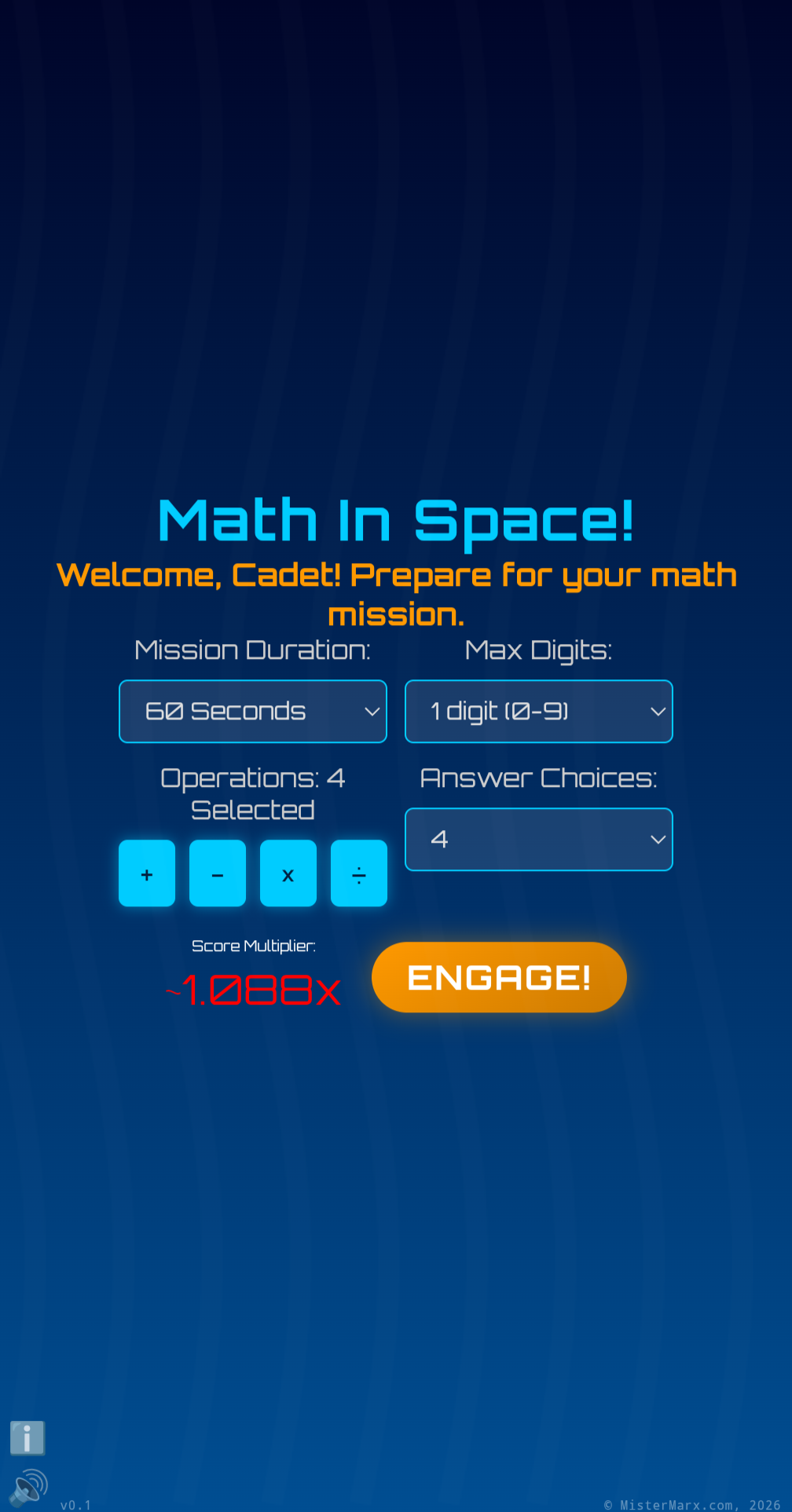
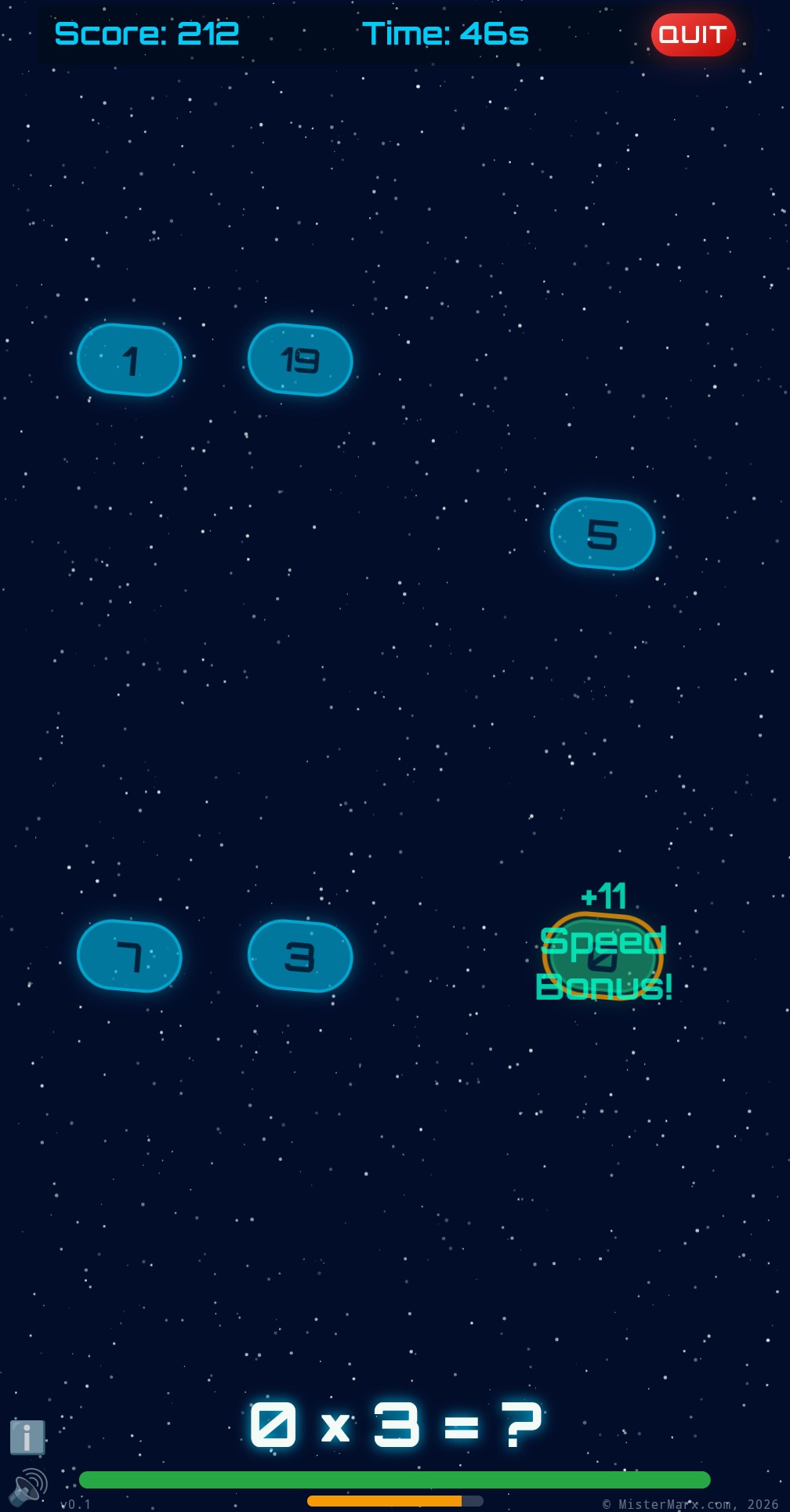
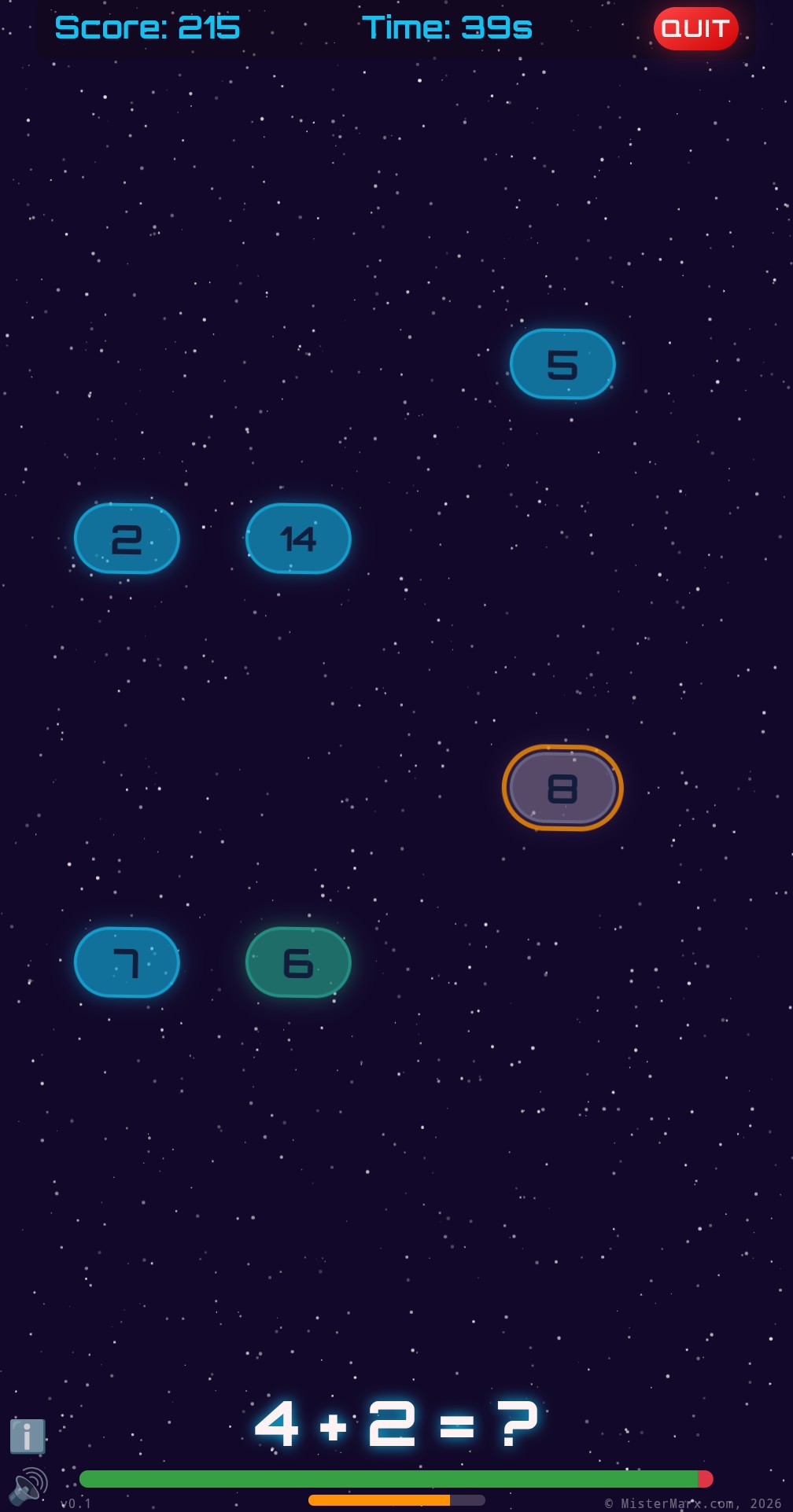
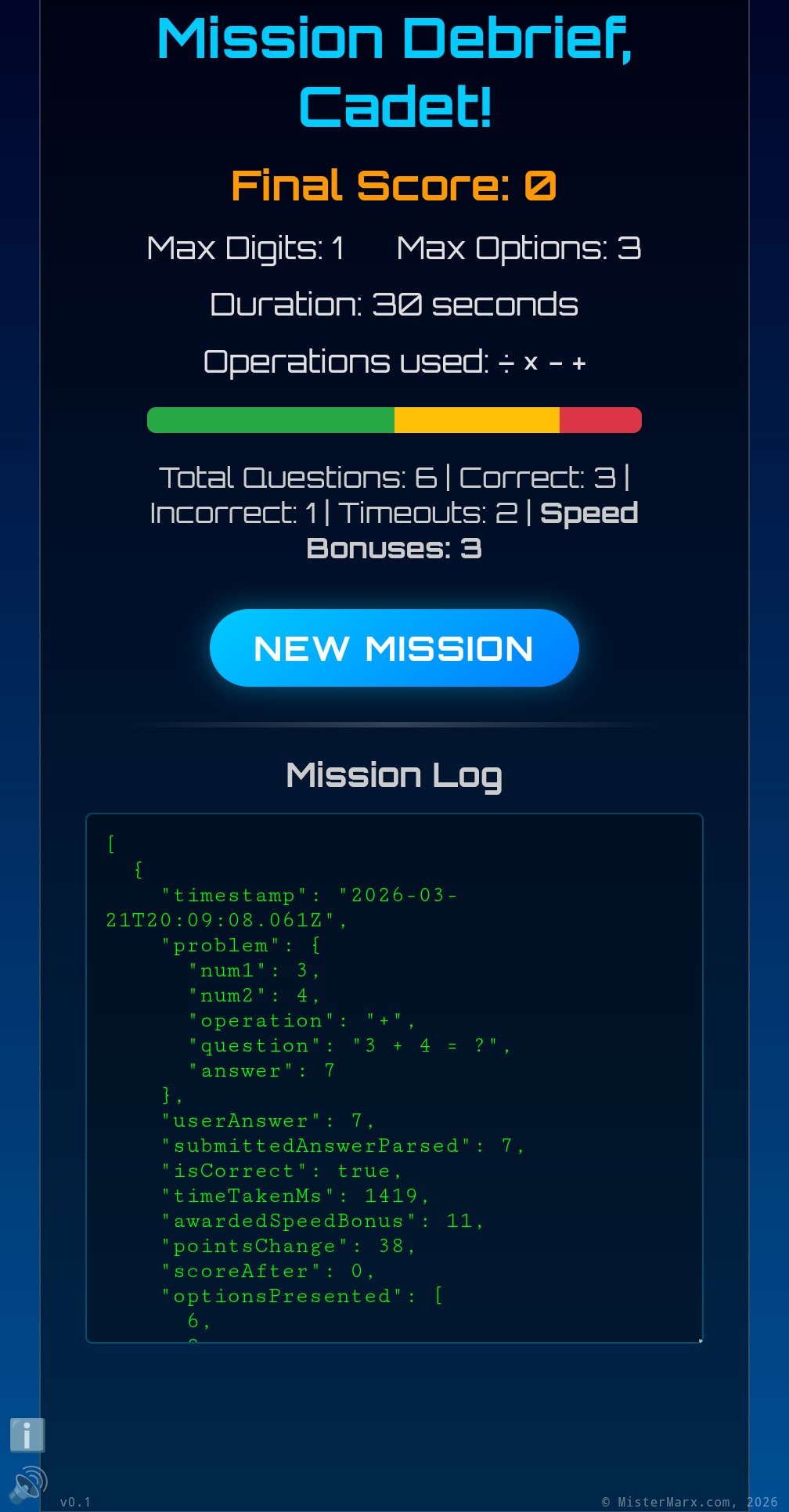
read → calculate → locate → select → feedback → next
The game is timed, focused, and progressive. The player reads the math problem, calculates the answer, finds the correct option among floating ships, selects it, and receives immediate feedback before the next problem appears.
This is not a calm worksheet exercise. It is a timed arithmetic game where the player must balance speed, accuracy, and mental calculation under pressure.
This companion page explains the play experience, the habits of mind the game can develop, and the kinds of mathematical skills players practice during gameplay.
The Mathematical Habits of Mind framework originates from research on mathematics curriculum design emphasizing reasoning, conjecture, and structural thinking (Cuoco, Goldenberg, & Mark, 1996) and is further developed in MisterMarx.com's educational approach (MisterMarx.com, 2026) . This approach builds on research showing that games create effective learning environments (Gee, 2003) , support cognitive development (Green & Bavelier, 2003) , and benefit from structured mathematical discussions (Stein, Engle, Smith, & Hughes, 2008) .
This companion page builds on established research in mathematics education, cognitive development, and game-based learning.
Mathematical Habits of Mind: Mathematics education should cultivate ways of thinking, not just procedures (Cuoco, Goldenberg, & Mark, 1996) .
Mathematical Discussion Theory: The 5 Practices framework for turning activity into reasoning .
Game-Based Learning: Games create situated problem-solving environments (Gee, 2003) .
Cognitive Skill Development: Action games improve attention and decision making (Green & Bavelier, 2003) .
Math In Space's design supports Mathematical Habits of Mind through explicit arithmetic practice under time pressure, immediate feedback on accuracy, and progressive difficulty. Players develop mathematical reasoning while building computational fluency (Cuoco, Goldenberg, & Mark, 1996) as applied in MisterMarx.com's educational approach (MisterMarx.com, 2026) .
The ratings below show which Mathematical Habits of Mind are most strongly activated by the actual play experience of MATH IN SPACE.
These scores are not claims about all games in general. They describe how strongly MATH IN SPACE appears to activate each Mathematical Habit of Mind through its actual play experience.
The player must constantly interpret mathematical expressions and evaluate multiple answer choices under time pressure (MisterMarx.com, 2026) .
Strong play depends on being able to explain why one answer choice is correct while others are mathematically incorrect (MisterMarx.com, 2026) .
Players improve by recognizing operation patterns, number relationships, and common mistake patterns in the answer choices (MisterMarx.com, 2026) .
The game repeatedly asks players to recover from incorrect answers, rethink strategies, and continue improving accuracy under pressure (MisterMarx.com, 2026) .
Errors are immediately visible with visual feedback, making mistakes highly informative for understanding mathematical relationships (MisterMarx.com, 2026) .
Players develop different mental calculation strategies and compare efficiency of approaches for speed bonuses (MisterMarx.com, 2026) .
Players can clearly describe their calculation process, identify where errors occurred, and explain correct mathematical reasoning (MisterMarx.com, 2026) .
The results screen supports reflection on calculation strategies, timing decisions, and accuracy patterns (MisterMarx.com, 2026) .
Players form broad rules about operation properties, number sense, and efficient calculation strategies from repeated play (MisterMarx.com, 2026) .
Good play depends on connecting mathematical operations to real-time decision making and understanding how accuracy affects overall performance (MisterMarx.com, 2026) .
The game naturally produces real questions about calculation efficiency, number relationships, and mathematical reasoning under pressure (MisterMarx.com, 2026) .
The game represents mathematical expressions as visual problems that players must decode and solve mentally (MisterMarx.com, 2026) .
Some Mathematical Habits of Mind appear most strongly during discussion rather than during solo gameplay.
These habits emerge most clearly when gameplay is paired with conversation, reflection, and comparison of strategies.
The MATH IN SPACE game teaches both specific grade-level mathematical content and mathematical thinking behaviors. Players practice arithmetic operations at different difficulty levels (from single-digit to multi-digit numbers) while developing mathematical reasoning. Alignment is evaluated against both the Common Core Content Standards and the Common Core Standards for Mathematical Practice (CCSS-MP).
Players constantly interpret mathematical expressions and determine correct answers under time pressure. Incorrect answers result in point penalties and immediate feedback showing the correct answer, encouraging players to learn from mistakes and improve accuracy on subsequent problems.
Gameplay Evidence:
Players reason about numerical relationships, operation properties, and quantitative comparisons between answer choices. Quantitative relationships guide strategic decisions.
Gameplay Evidence:
While the game itself is single-player, discussion about strategies allows players to justify calculation methods and evaluate alternative problem-solving approaches.
Gameplay Evidence:
The game represents mathematical operations as visual problems that players must solve mentally, modeling arithmetic relationships in a dynamic format.
Gameplay Evidence:
Players develop mental calculation strategies and use the game's visual feedback system as a tool for mathematical verification.
Gameplay Evidence:
Successful play requires accurate mental calculations and precise selection of correct answers from similar-looking choices.
Gameplay Evidence:
Strategic play depends on recognizing patterns in mathematical operations, number relationships, and problem structures.
Gameplay Evidence:
Repeated play reveals patterns in mathematical operations, allowing players to develop efficient calculation strategies and recognize common mistake patterns.
Gameplay Evidence:
Math In Space uses transparent scoring mechanics that are immediately visible to players. The focus should be on discussing calculation strategies and mathematical reasoning. All game mechanics are explicitly designed to support arithmetic practice and computational fluency development.
Keep sessions short and reflective. A strong routine is play → pause → explain → play again. That turns the game into a mathematical thinking tool instead of passive screen time.
Your child does not need every scoring rule explained in advance. In many cases, it is better to ask what they notice about the mathematics, what they predict about number patterns, and what they think caused calculation success or errors. That helps the game become a mathematical thinking experience rather than just an instruction-following experience.
Part of the game is mathematical pattern recognition. Pay attention to what seems to make a calculation strategy more efficient, what makes answer choices reasonable, and what mathematical patterns lead to success. Your task is not just to play. Your task is to notice and wonder about the mathematics.
Research on productive mathematics discussions identifies five instructional practices: anticipating, monitoring, selecting, sequencing, and connecting student thinking (Stein, Engle, Smith, & Hughes, 2008) .
Predict the kinds of calculation strategies students will use: rushing through problems, using inefficient methods, making common operation mistakes, or focusing on speed over accuracy.
Watch and listen for how students justify their calculation methods, how they react to time pressure, and whether they are using efficient mental strategies or lengthy written calculations.
Choose students whose approaches show contrasting reasoning: careful step-by-step calculation, intuitive number sense, strong error recovery, or efficient mental shortcuts.
Share examples in an order that helps the class move from basic calculation descriptions toward deeper mathematical reasoning about number relationships and operation properties.
Connect one player's calculation strategy to another's so students can see how different approaches reveal larger mathematical habits of mind and number sense.
The player must stay focused on mathematical problems while managing time pressure and visual scanning of answer choices.
Players keep multiple calculation steps, answer choices, and time constraints in mind simultaneously.
The game constantly asks which calculation strategy deserves attention now versus which can wait for later problems.
Players must recover from calculation errors and time pressure without becoming frustrated or giving up.
Repeated problem types train noticing and using recurring number patterns and operation properties.
The game constantly asks players to make quick, accurate mathematical decisions under strict time constraints.
MATH IN SPACE is strongest educationally when gameplay is paired with brief reflection, comparison of calculation strategies, and explicit attention to Mathematical Habits of Mind.
The game MATH IN SPACE is best understood as a game of intentional mathematical calculation under time pressure. Its strongest educational value lies in how strongly it activates key Mathematical Habits of Mind, especially making sense, justifying why, recognizing regularity and structure in numbers, persevering through calculation challenges, learning from mathematical mistakes, and refining mathematical judgment through reflection - (Cuoco, Goldenberg, & Mark, 1996) and implemented through MisterMarx.com's educational approach (MisterMarx.com, 2026) .
Like many strong educational games, MATH IN SPACE teaches through mathematical experience rather than instruction. Play builds computational fluency and mathematical reasoning through repeated practice and immediate feedback.
The game MATH IN SPACE makes mathematical thinking visible. The score gradually becomes a record of how the player is calculating, reasoning, recognizing patterns, and revising mathematical strategies. The score reflects the quality of the player's mathematical judgment over time.
Companion pages may include MisterMarx.com resources, educational research, and standards references. These help explain what a game develops, how the experience can be used intentionally, and which mathematical practices or habits of mind are most strongly involved.