ANTICIPATING
Predict the kinds of path strategies students will use: chasing the target too quickly, overlooking exactness, ignoring future board damage, missing shorter paths, or failing to use backtracking productively.
This page is designed to help parents, teachers, and students understand what SIGMA PRIME develops during play. The primary focus is Mathematical Habits of Mind. Additional cognitive and strategic benefits are included secondarily.
SIGMA PRIME is a constraint-based prime path strategy game in which players build orthogonally connected paths through live cells to exactly match a current Σ target while managing decay pressure, recovery opportunities, and board-state change across 10 goals.
Important: SIGMA PRIME is not best understood as an answer-selection or arithmetic-drill game.
Its core play is constraint-based mathematical strategy: players must construct valid prime-valued paths,
satisfy exact summation targets, and manage a changing board under time pressure. It develops reasoning,
planning, pattern recognition, decision-making, and reflection through play, while repeated addition and
prime composition function inside that larger strategic system.
These are exactly the kinds of habits Mathematical Habits of Mind literature argues mathematics education should cultivate.
SIGMA PRIME feels like managing a live mathematical system under pressure. The player scans the board, commits to a starting cell, builds a path through orthogonally adjacent prime-valued cells, backtracks when needed, watches the running total, and tries to land exactly on the current Σ target before decay and timing pressures make the board less forgiving. Success feels corrective and stabilizing. Failure has consequences. The player is coordinating exact summation, spatial legality, timing, and board-state strategy.
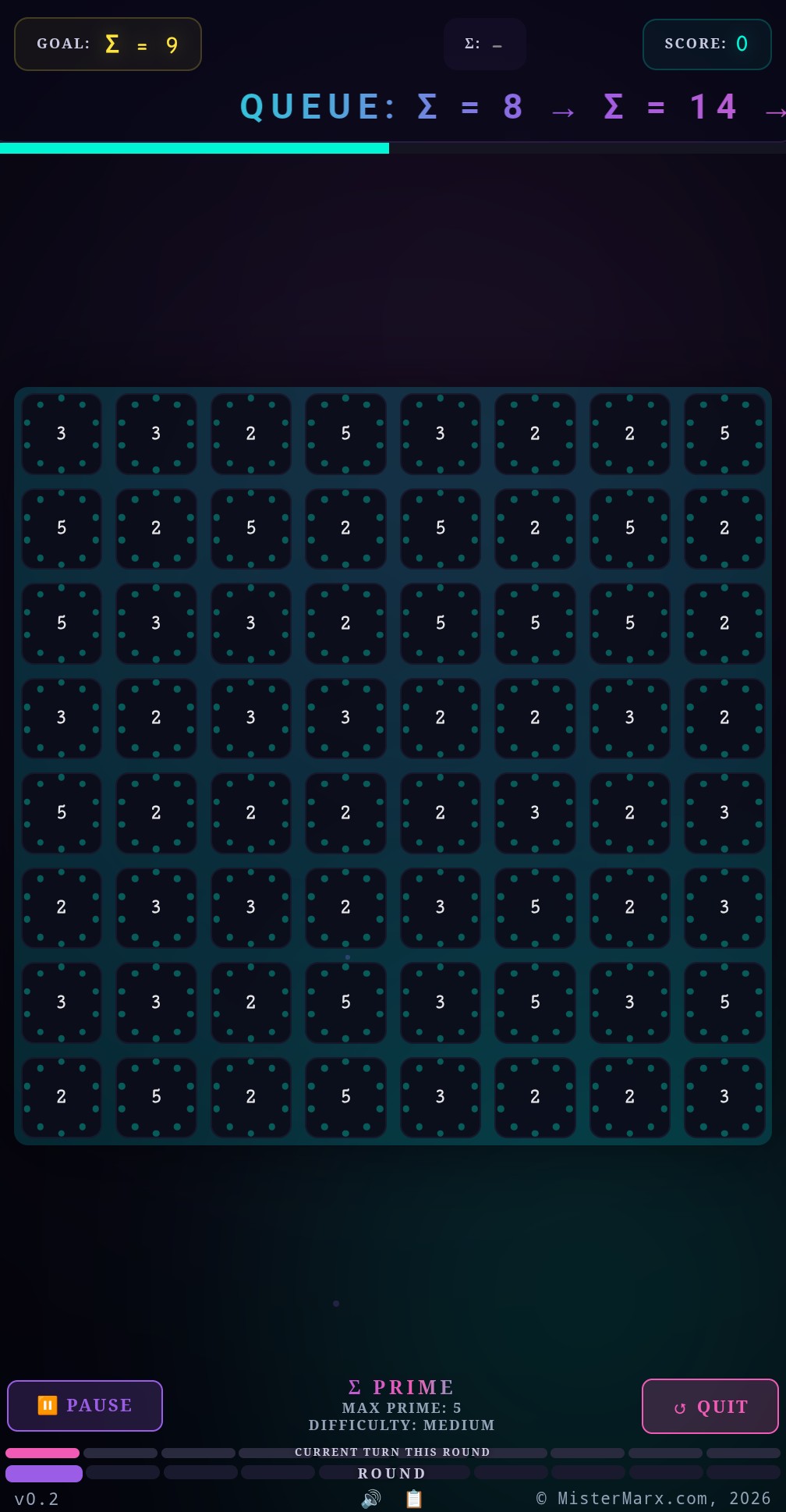
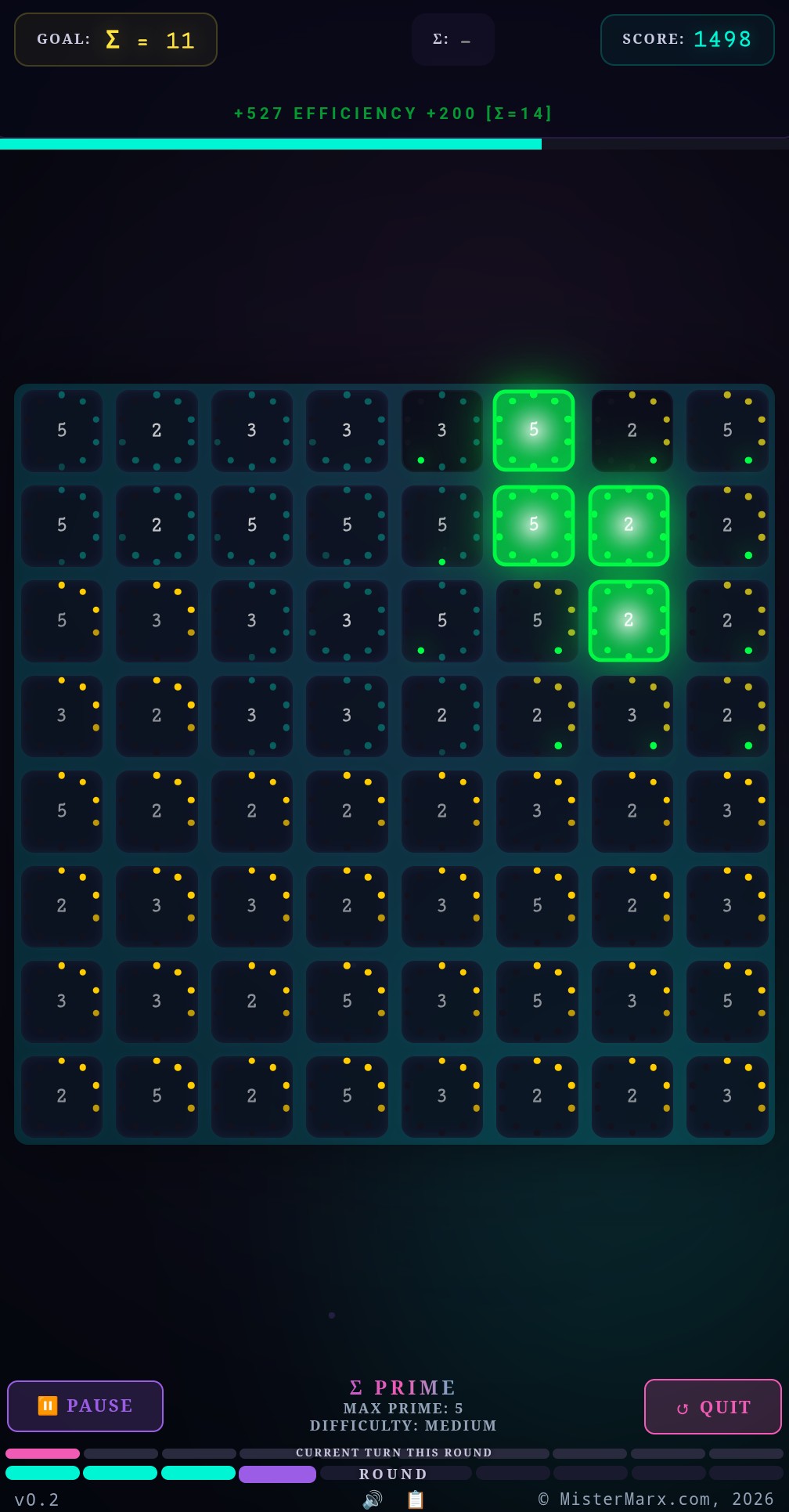
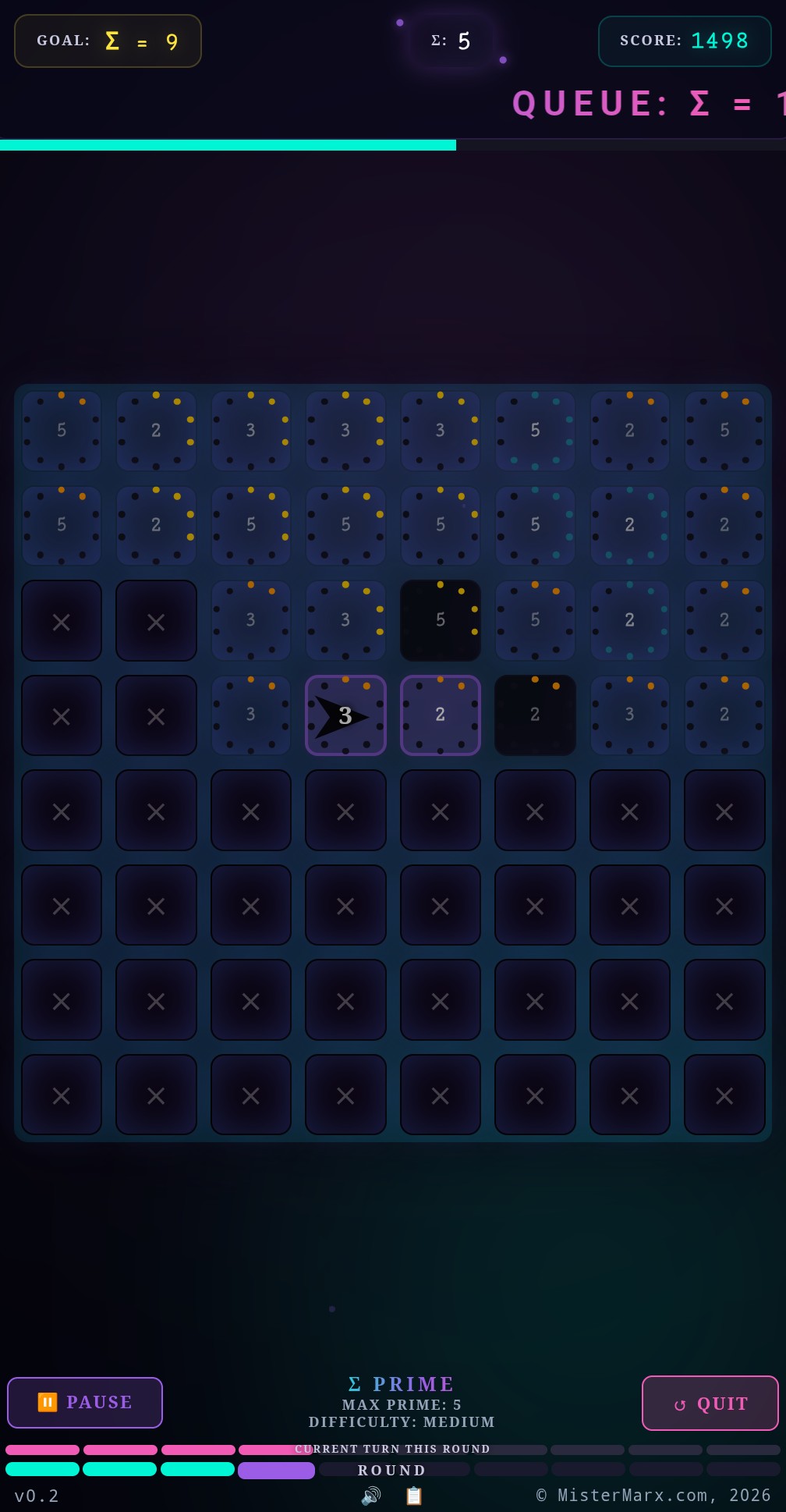
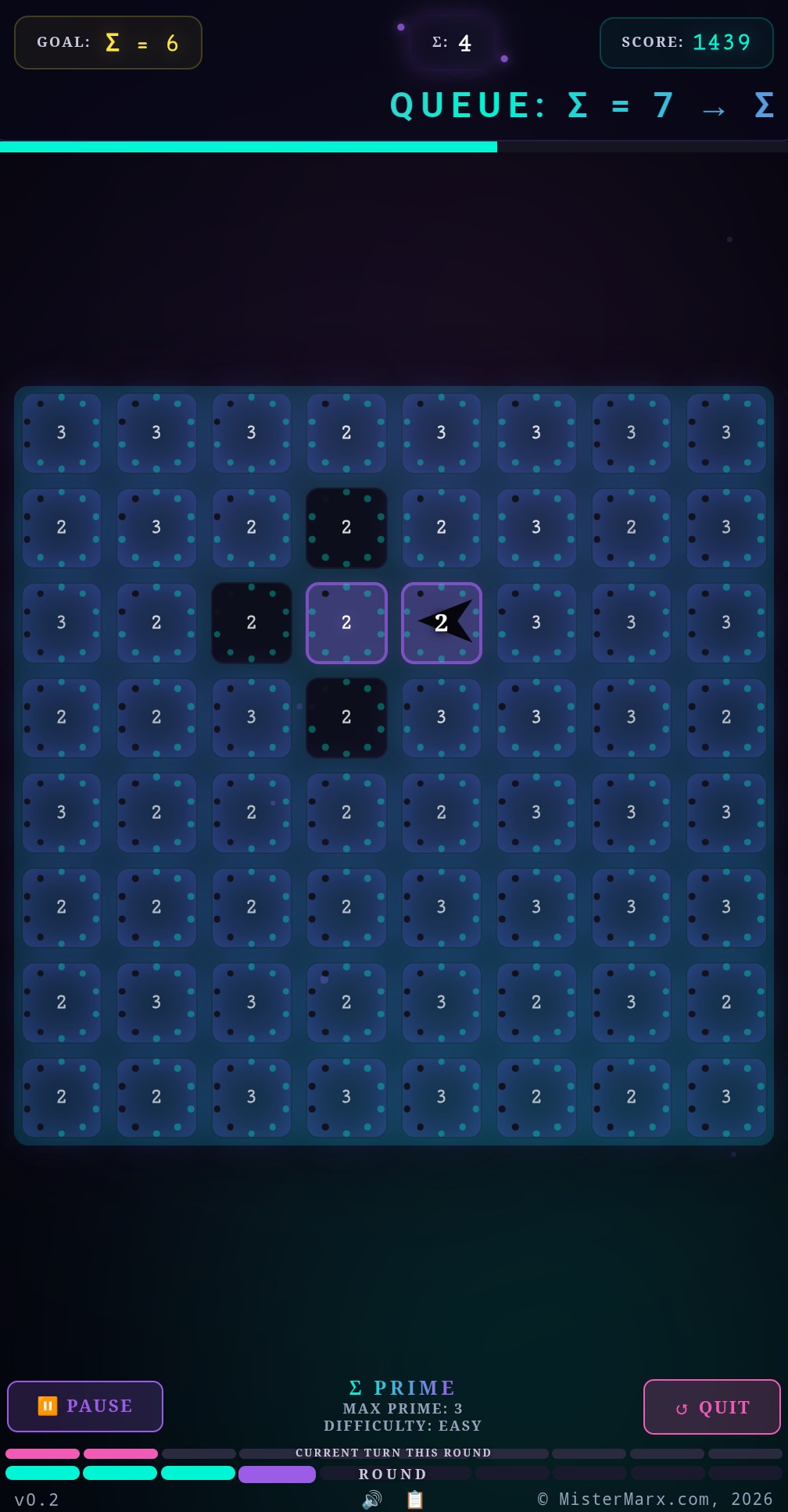
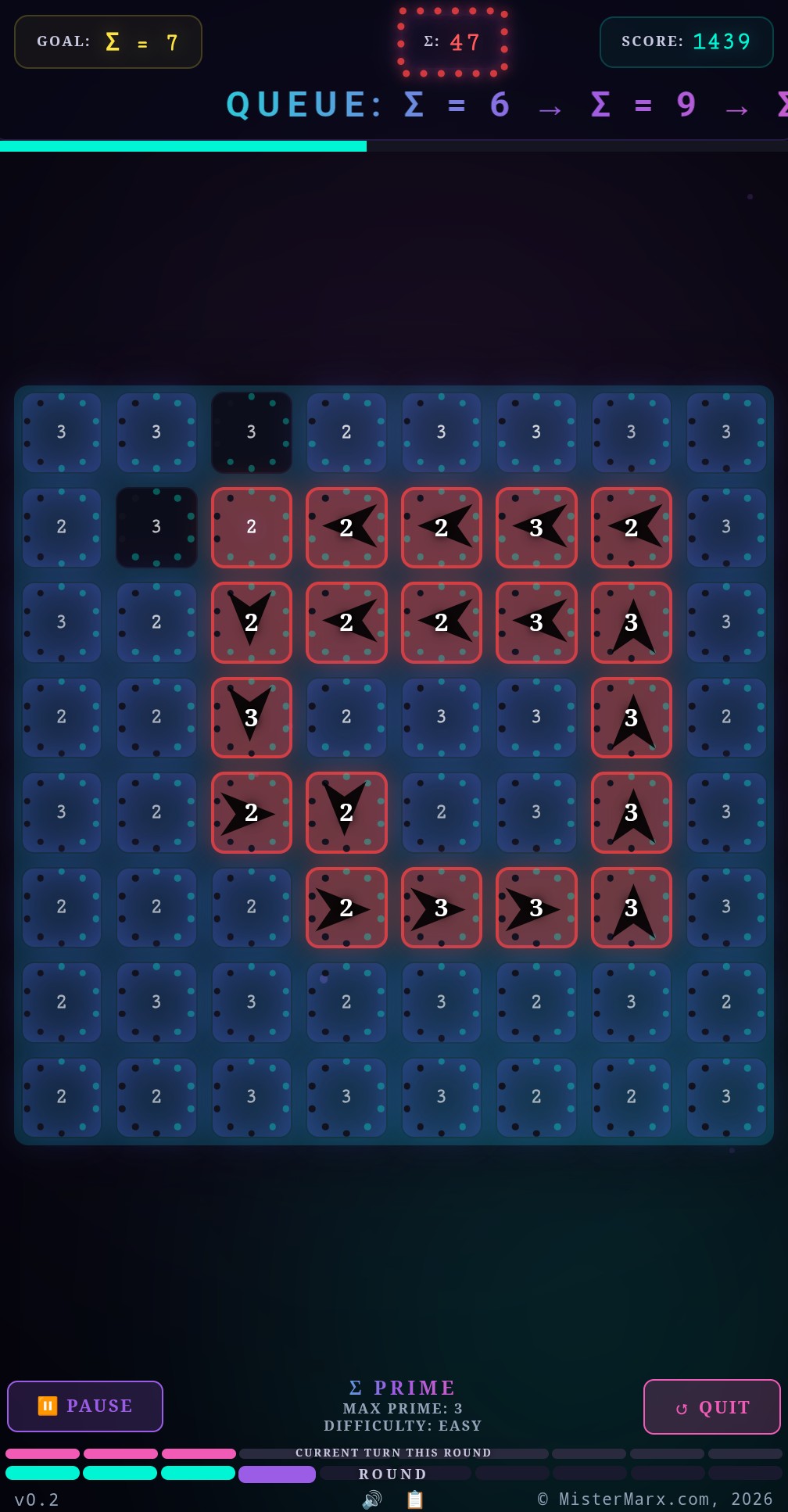
scan → path-build → sum-check → submit → board-change → next target
The game is timed, state-dependent, and progressive. The player scans live cells, constructs a path through orthogonally adjacent primes, checks the running total against the Σ target, submits for an exact match, and then responds to the resulting refresh, healing, revival, decay, and timer pressure before the next target.
This is not a worksheet-style answer game. It is a timed mathematical strategy game where the player must balance exact summation, spatial planning, board preservation, recovery decisions, and speed under pressure.
This companion page explains the play experience, the habits of mind the game can develop, and the mathematical structures players engage with during gameplay.
The Mathematical Habits of Mind framework originates from research on mathematics curriculum design emphasizing reasoning, conjecture, and structural thinking (Cuoco, Goldenberg, & Mark, 1996) and is further developed in MisterMarx.com's educational approach (MisterMarx.com, 2026) . This approach is especially relevant for SIGMA PRIME because the game does not center on answer selection or routine arithmetic rehearsal. Instead, it places players inside a live mathematical system where they must coordinate exact summation, spatial constraint, path revision, board preservation, and time pressure.
This companion page builds on established research in mathematics education, cognitive development, and game-based learning, but interprets those ideas through the actual structure of SIGMA PRIME: a constraint-based prime path strategy game.
Mathematical Habits of Mind: Mathematics education should cultivate ways of thinking, not just procedures (Cuoco, Goldenberg, & Mark, 1996) .
Mathematical Discussion Theory: Structured discussion can turn activity into reasoning when players compare strategies, explain choices, and analyze outcomes (Stein, Engle, Smith, & Hughes, 2008) .
Game-Based Learning: Games create situated problem-solving environments (Gee, 2003) .
Cognitive Skill Development: Real-time games can strengthen attention, monitoring, and decision making (Green & Bavelier, 2003) .
SIGMA PRIME supports Mathematical Habits of Mind not through answer-choice arithmetic, but through exact additive construction inside a constrained spatial system. Players must evaluate reachable sums, test candidate paths, backtrack when needed, preserve live cells, recover dead zones, and decide when a mathematically valid path is strategically worth using. This places reasoning, structure, and decision-making at the center of play (Cuoco, Goldenberg, & Mark, 1996) as applied in MisterMarx.com's educational approach (MisterMarx.com, 2026) .
The ratings below show which Mathematical Habits of Mind are most strongly activated by the actual play experience of SIGMA PRIME.
These scores are not claims about all games in general. They describe how strongly SIGMA PRIME appears to activate each Mathematical Habit of Mind through its actual play experience: exact summation, orthogonal path construction, board-state management, decay pressure, recovery, and strategic revision.
The player must continuously make sense of a changing prime-valued board, the current Σ target, reachable paths, and whether a partial sum can still be completed exactly (MisterMarx.com, 2026) .
Strong play depends on being able to justify why a chosen path is valid, why it reaches the exact target, and why it is strategically preferable to competing options (MisterMarx.com, 2026) .
Players improve by recognizing repeatable additive structures, prime combinations, local board patterns, and recurring path possibilities under orthogonal movement constraints (MisterMarx.com, 2026) .
The game repeatedly asks players to recover from failed sums, board decay, and path dead-ends, then continue searching for exact and strategically useful solutions (MisterMarx.com, 2026) .
Mistakes are highly informative because they expose unreachable totals, poor path choices, weak board stewardship, or missed recovery opportunities in a visibly changing system (MisterMarx.com, 2026) .
The same target can often be reached through multiple legal paths, and strong play requires comparing those alternatives for length, safety, recovery value, and future board consequences (MisterMarx.com, 2026) .
Players can explain how a path was built, why it satisfied the target exactly, where an attempt failed, and how board-state considerations changed the decision (MisterMarx.com, 2026) .
Players can reflect on whether they chased totals too locally, ignored better future board states, rushed submission, or used recovery mechanics effectively (MisterMarx.com, 2026) .
Players gradually form general rules about reachable exact sums, efficient path construction, prime-value combinations, and when certain local shapes tend to produce useful targets (MisterMarx.com, 2026) .
Good play depends on connecting number structure, path geometry, cell life, revival possibilities, timer pressure, and future board control into a single coordinated decision (MisterMarx.com, 2026) .
The game naturally generates real questions about exact reachability, efficient path selection, board recovery, tradeoffs between short-term success and long-term survival, and the structure of prime sums (MisterMarx.com, 2026) .
The game turns exact additive composition into a visual-spatial representation: numbers live on a board, legality depends on adjacency, and success depends on constructing a valid path rather than selecting an answer (MisterMarx.com, 2026) .
Some Mathematical Habits of Mind appear most strongly when SIGMA PRIME gameplay is paired with discussion rather than left as solo play alone.
These habits emerge most clearly when gameplay is paired with conversation, reflection, replay analysis, and comparison of alternative path strategies.
SIGMA PRIME aligns strongly with the Common Core Standards for Mathematical Practice because its core mechanics require players to make sense of exact-sum targets, reason quantitatively about prime-valued paths, revise strategies through backtracking, attend to precision, and recognize additive structure under spatial constraints. Rather than selecting answer choices, players construct mathematically valid paths through orthogonally adjacent live cells while managing decay, recovery, and board-state consequences under time pressure.
Every target in SIGMA PRIME is a constrained problem: the player must determine whether an exact sum is reachable from the current live board through a legal orthogonal path, and must continue revising when an early route fails.
Gameplay Evidence:
Players continually track quantities, partial sums, exact remaining difference to target, and the quantitative consequences of extending or revising a path through prime-valued cells.
Gameplay Evidence:
While gameplay is single-player, the game supports mathematical argument when players explain why a path is valid, why it reaches the exact target, and why one route is strategically stronger than another.
Gameplay Evidence:
SIGMA PRIME turns additive composition into a live visual model: numbers are embedded in a grid, legal movement matters, and mathematical success depends on constructing a valid path through the system.
Gameplay Evidence:
The player uses the game interface strategically: path preview, backtracking, board reading, and timing awareness function as tools for exact reasoning and decision-making.
Gameplay Evidence:
The target must be matched exactly. Precision is not optional: a path that misses the total, breaks adjacency, or relies on unavailable cells fails mathematically and strategically.
Gameplay Evidence:
Strong play depends on seeing additive structure in prime combinations, local board geometry, reachable clusters, and recurring path shapes that make some targets more accessible than others.
Gameplay Evidence:
Over repeated play, players begin to recognize regularities in exact-sum construction, prime-value combinations, efficient path length, and board recovery patterns, then use those regularities to act faster and better.
Gameplay Evidence:
Although SIGMA PRIME is best aligned to the Standards for Mathematical Practice, it also connects to Common Core content work involving addition, decomposition and composition of numbers, number patterns, strategic use of structure, and precise quantitative reasoning. The exact content standard emphasis will depend on how the game is used instructionally and at what grade band.
SIGMA PRIME uses transparent scoring and board-state consequences that are visible to players. The instructional focus should remain on exact summation, valid path construction, strategic backtracking, and the tradeoff between immediate success and long-term board control. The game supports mathematical reasoning through constraint, precision, and structure rather than through answer-choice fluency practice.
Keep sessions short and reflective. A strong routine is play → pause → explain → play again. That turns the game into a mathematical strategy and reasoning tool instead of passive screen time.
Your child does not need every scoring or board rule explained in advance. In many cases, it is better to ask what they notice about exact sums, legal paths, prime combinations, decay pressure, and recovery opportunities. That helps the game become a mathematical thinking experience rather than just an instruction-following experience.
Part of the game is learning to see structure. Pay attention to which prime combinations help you hit exact targets, which path shapes work well, when backtracking saves a move, and how success or failure changes the board. Your task is not just to play fast. Your task is to notice, test, and improve your mathematical decisions.
Research on productive mathematics discussions identifies five instructional practices: anticipating, monitoring, selecting, sequencing, and connecting student thinking (Stein, Engle, Smith, & Hughes, 2008) . In SIGMA PRIME, these practices apply to how students build exact-sum paths, revise through backtracking, manage board decay, and compare mathematically valid but strategically different solutions.
Predict the kinds of path strategies students will use: chasing the target too quickly, overlooking exactness, ignoring future board damage, missing shorter paths, or failing to use backtracking productively.
Watch and listen for how students justify a path, track the running total, react to decay pressure, and decide whether a mathematically valid route is also strategically strong.
Choose students whose solutions reveal contrasting reasoning: shortest exact path, high-recovery path, risky path under time pressure, or a failed path that reveals an important misconception.
Share examples in an order that helps the class move from simple exact-sum paths toward deeper reasoning about efficiency, structure, recovery, and future board consequences.
Connect one player's path strategy to another's so students can see how exact summation, adjacency, board-state management, and mathematical habits of mind work together.
Players must stay focused on the Σ target, the running total, legal adjacency, and the changing condition of the board.
Players hold partial sums, candidate path options, dead-cell constraints, and future board consequences in mind at the same time.
The game constantly asks which path, target approach, or recovery opportunity deserves attention now versus what should be preserved for later goals.
Players must recover from failed submissions, shrinking options, and faster timer pressure without collapsing into impulsive play.
Repeated play supports noticing prime-sum combinations, efficient path shapes, and board patterns that make exact targets more or less reachable.
SIGMA PRIME constantly asks players to make exact mathematical and strategic decisions under accelerating time pressure.
SIGMA PRIME is strongest educationally when gameplay is paired with brief reflection, comparison of alternative exact-sum paths, and explicit attention to Mathematical Habits of Mind.
The game SIGMA PRIME is best understood as a constraint-based mathematical strategy game built around exact summation, orthogonal path construction, prime-number structure, and board-state management under time pressure. Its strongest educational value lies in how strongly it activates key Mathematical Habits of Mind, especially making sense, justifying why, recognizing regularity and structure, persevering through difficulty, learning from mistakes, and refining judgment through reflection - (Cuoco, Goldenberg, & Mark, 1996) and implemented through MisterMarx.com's educational approach (MisterMarx.com, 2026) .
Like many strong educational games, SIGMA PRIME teaches through mathematical experience rather than direct instruction. Play develops exact additive reasoning, strategic planning, pattern recognition, and decision-making through repeated interaction with a changing system.
SIGMA PRIME makes mathematical thinking visible. The score and board state gradually become a record of how the player is summing, reasoning, recognizing structure, revising paths, and managing future possibilities. The score reflects the quality of the player's mathematical judgment over time.
Companion pages may include MisterMarx.com resources, educational research, and standards references. These help explain what a game develops, how the experience can be used intentionally, and which mathematical practices, habits of mind, and Common Core connections are most strongly involved in SIGMA PRIME.